Orginal Source: Buzz Magazine
http://edition.pagesuite-professional.co.uk/launch.aspx?eid=86b99faf-a350-41d9-b4e1-08cb837a8d92&pnum=8
Of all the female attire to come under fire, the veils worn by Muslim
women are perhaps the most controversial—fuelling debates, restrictions and legislation all across Canada and Europe. As the issue remains a hot button topic, the
women who are supposedly meant to be shielded and hidden have instead been thrust into the spotlight.
BURKAS OVER BONNETS—THE FOCUS ON MUSLIM DRESS CODE
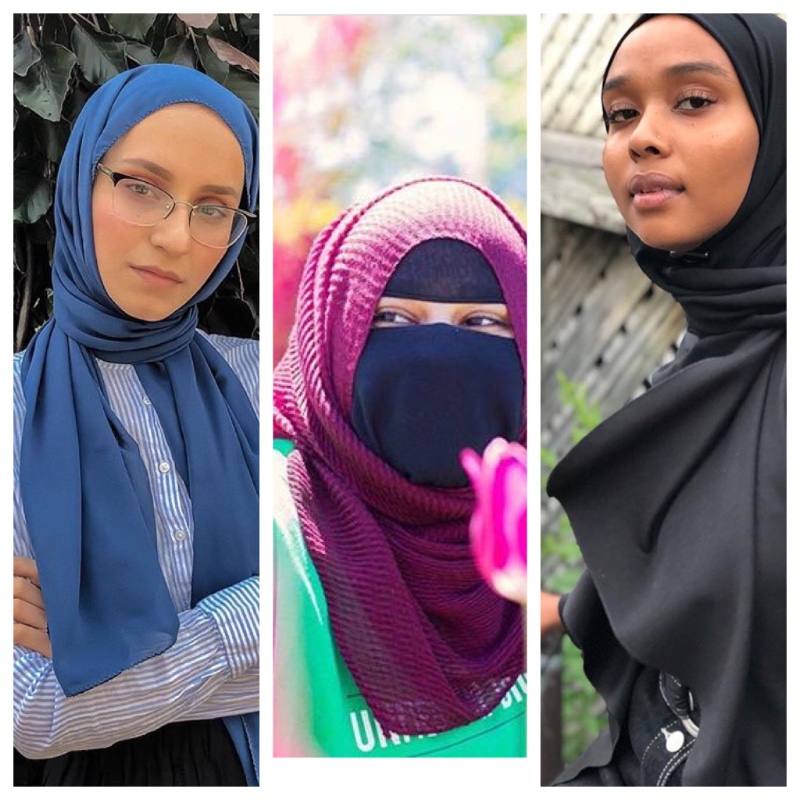
While most of us are quick to offer up an opinion on the subject, few of us actually fully understand the differences between a burka (a veil that covers the entire face and body with a mesh window over the eyes) and a niqab (a veil that covers the head and face, but is open around the eyes), let alone grasp the complexities of the issue. Here in Canada, we typically see hijabs (a headscarf that covers the hair and neck) more often than full face-covering veils, but even as these garments become more of a focal point in our societal landscape, they continue to test the limits of multicultural acceptance.
Executive director of the Canadian Council of Muslim Women (CCMW) Alia Hogben says it’s time to let it be. “Why aren’t we discussing how Amish women dress?” she asks. “How come we’re not talking about their clothes? As far as we’re concerned it’s basically an anti-Muslim stance and another form of discrimination and racism.”
Yet, there doesn’t seem to be a unilateral stance on the issue among all Muslim women. There are those who believe that tolerating these veils only propels the oppression of the women who are forced to wear them. “The burka is an oppressive garb that endorses patriarchy,” says Farzana Hassan, a well-known author, speaker, activist and former president of the Muslim Canadian Congress.
“Women who state they do it out of choice succumb to more hellfire and brimstone preaching. It is succumbing to fear more than making an informed choice.”
TO WEAR OR NOT TO WEAR, WHOSE CHOICE IS IT?
A recent study by the CCMW of niqabi women across Ontario found that while 44% of the 81 women sampled put on the niqab for religious beliefs, 34% choose to wear it as an expression of personal identity. Not one of the participants said they were forced to dress in a niqab. Stephanie Roy, an Acadian Muslim convert who wears a hijab does not feel that the niqab is an Islamic necessity, but will still defend those women who do choose to wear it. “The examples of diverse Muslim women are endless and yet it seems like a consensus has been made without a shred of evidence that we are all voiceless, oppressed and brainwashed,” says the self-described intersectional feminist and human rights advocate. “Ensuring women
have the freedom to make their own decisions also means supporting them no matter what their decisions might be.”
FINDING BALANCE BETWEEN TRADITION AND PROGRESS
Niqabi defendants argue the criminalization of face coverings in France or the Harper government’s push to ban veils during the citizenship oath ceremony come as a setback to the equality movement and only subjugate women further. Still others believe imposing certain privileges on niqabi women contradicts the modern values that we hold here in Canada. Hogben says that while her organization objects to places like Iran and Saudi Arabia forcing women to put on a niqab or hijab, they are just as opposed to Canada or France imposing the opposite policy by saying women must uncover their heads or faces.
“We can’t tell a woman how to dress,” says Hogben. “And we certainly don’t think Mr. Harper has the right to tell women how to dress.”
Of course there are exceptions, and respect is a two-way street. Many feel that at the very least niqabi women should be expected to reveal their faces for identification purposes. The women polled by the CCMW were not opposed to the idea, if requested. Admittedly, these are Muslim women who felt comfortable enough to take the survey, and they also made it clear they are never forced into covering their faces. “I think we need to scrutinize how women are coerced to wear or not wear a headscarf,” says Roy, a hijab-wearing convert. “But I don’t believe that hijab-clad or even niqab-clad women are necessarily any more problematic than a man in a baseball cap.”
CRITICISM CROSSING CULTURAL REALMS
There are Muslim women who are forced to wear niqabs and burkas, and it’s an issue that should not be ignored. But it’s also hard to deny the social pressure applied to women of all cultures to look and dress in a particular way.
Regardless of race or religious background, many women are fighting a battle over self-identity. For instance, the emancipation of western women often directly correlates with our freedom to show off our bodies. However, the resulting hypersexualization of women in our society can be just as dehumanizing as the so-called oppressive burka or niqab. “I think we should be attacking how women
are portrayed as sexual objects in all kinds of advertising,” says Hogben. “How come they don’t do something about that?” Whether the clothing in question is a burka
or a bikini, there doesn’t seem to be a one- size-fits-all answer.